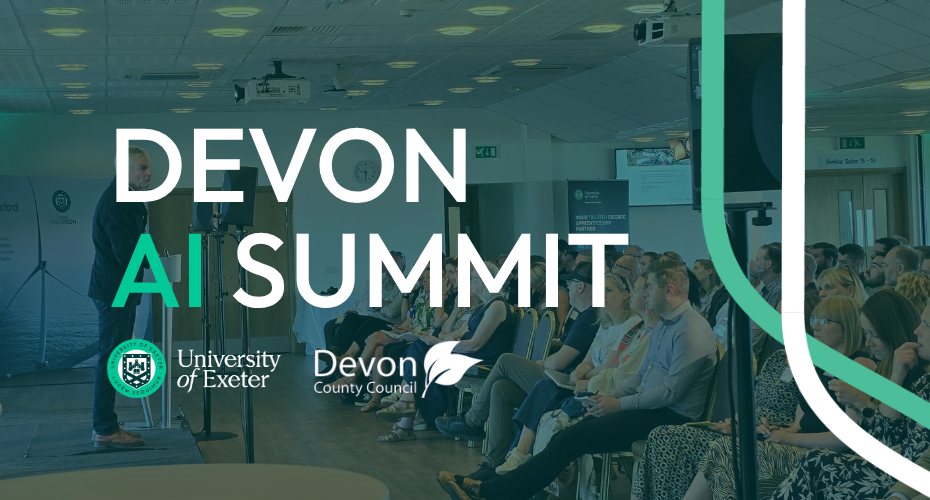
Devon AI Summit Returns in 2026
The Devon AI Summit returns for its second year on Thursday 5 November, bringing businesses, researchers and experts from across Devon and the South West together at Sandy Park, Exeter.

Research and Innovation blog
Category
The Devon AI Summit returns for its second year on Thursday 5 November, bringing businesses, researchers and experts from across Devon and the South West together at Sandy Park, Exeter.
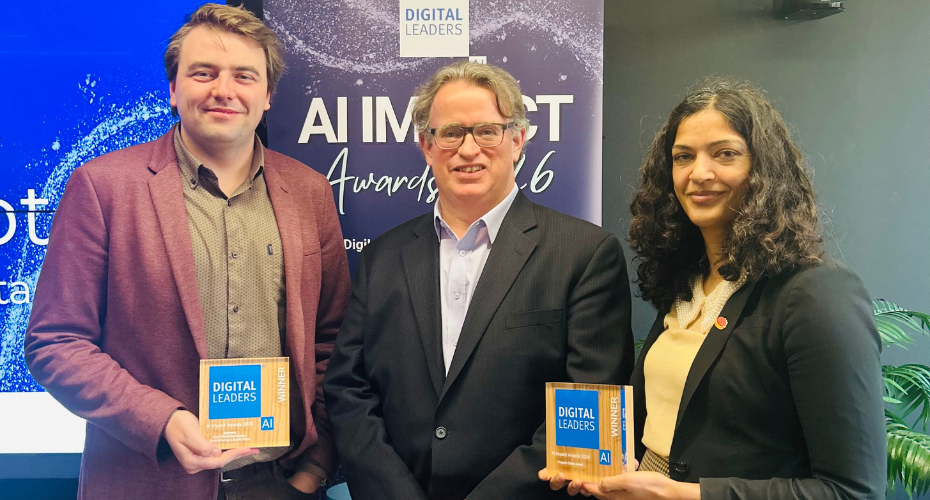
DIGITLab, an EPSRC Next Stage Digital Economy Centre led by Prof Saeema Ahmed-Kristensen, has won two awards at the Digital Leaders AI Impact Awards for its innovative data and AI stakeholder programme.

As the final two UK‑Shared Prosperity Fund projects delivered by the University of Exeter in Cornwall draw to a close at the end of March, we are celebrating the achievements and legacy of both The Future is Green (TFiG) and Digital Futures Cornwall.

We’re excited to announce that nominations for the 2026 Knowledge Exchange Awards are officially open! If you’re part of a project that has turned research expertise into real-world benefit, now is your chance to put it forward and be recognised.

Businesses will hear from leading experts at the Cornwall AI Summit A flagship event to help Cornwall businesses harness the potential of Artificial Intelligence (AI) has been announced by The University of Exeter.

A flagship event to help Devon businesses harness the potential of Artificial Intelligence (AI) has been announced by The University of Exeter.

A recent report from the University of Exeter and the Mozilla Foundation has investigated the potentially harmful effects of videos suggested to people on YouTube.

An Exeter researcher is among the winners of the British Science Association’s Award Lecture series for his research into online misinformation.

Dr Oleksandr Kyriienko, lead of the University of Exeter’s Quantum Dynamics, Optics, and Simulation group (QuDOS) is working in close partnership with Dutch start-up Qu & Co to develop quantum software with the potential to transform the way we use the huge power of quantum...

Using the expertise gained through their partnership with the University of Exeter, Applegate decided to set up the Covid-19 PPE Supply Hub, to link PPE customers with PPE suppliers throughout lockdown.

The University of Exeter works closely with the Met Office to tackle key challenges in weather and climate prediction as part of an in-depth Met Office Academic Partnership.

Since 2017, The University of Exeter have been working closely in partnership with Babcock, a leading provider of critical, complex engineering services which support national defence, save lives and protect communities.

University of Exeter works closely with the Met Office to tackle key challenges in weather and climate prediction as part of an in-depth Met Office Academic Partnership.

Apprentices on the Digital Technology Solutions (DTS) and Data Scientist (Professional) Degree Apprenticeships programmes have been able to keep working and studying throughout the Covid-19 pandemic thanks to programme directors and academic colleagues moving to flexible, online teaching.

Dr Oliver Stoner and Dr Theo Economou have developed an advanced yet highly interpretable statistical data model for capturing the behaviour of high resolution rainfall time series.

TIST is a network of farmers who have to date planted over 19 million trees. The University of Exeter is working with TIST to quantify and understand TIST’s impacts at landscape scales and on multiple sustainable development goals.

Since 2017, researchers at the University of Exeter have worked with the WHO to design a completely new bespoke statistical model for estimating worldwide use of specific fuels for cooking.

On Wednesday (July 15th), the University of Exeter and the Met Office will enter a partnership to create a Joint Centre for Excellence in Environmental Intelligence.

Professor Achim D. Brucker explains how we can keep our systems cyber secure while remote working.

An innovative new study, led by Edmond Awad from the University of Exeter’s Business School, looked at how people on different continents reacted to a new version of the famous ethical thought experiment, known as the “trolley dilemma”.

Data scientists, artificial intelligence experts and clinicians are among a range of professionals invited to join a new national network to find innovative ways of conducting dementia research and care.

A research project was undertaken between the University of Exeter and DC Welsh Water to develop a machine learning tool that could more accurately predict and identify potential blockages across the sewer network.

Seedata worked with Innovation, Impact and Business to jointly invest in new software to detect plagiarism.

Dr Sam Vine uses simulation technology and immersive media to help improve and understand learning and expertise.

Find out how the University of Exeter is helping to develop virtual reality training for pilots.

https://youtu.be/tKHLMPx2Gls Using online preoperative assessments could save the NHS £65 million per year, saving time for both nurses and patients.

Professor David B. Stephenson is Director of the Exeter Climate Systems (XCS) research centre, and based within the Mathematics department in the College of Engineering, Mathematics and Physical Sciences.

Biosciences researchers are using data from social media to find out about the impact climate change has on people’s lives.

Urban flood modelling is becoming more important as the population is increasingly urbanised. Flood modelling requires data on rainfall, land cover (whether the ground has roads, fields, buildings etc.), and soil type.
Choose which optional services may run. Necessary cookies used to make the website work are not affected.
Allows analytics tools to measure how the website is used.
Allows content from third-party services such as YouTube to load.